|
Leonidas
The classical connoisseur
UPDATE: [January 2011] After much umming and erring about whether to resurrect this blog from London, I’ve decided that I am too far away from China to be writing about it. But I will be blogging again when I’m back in the Orient, before too long a wait …
First things first: a couple of links. Here you can read my column in this month’s issue of Prospect magazine, on the influx of foreign students who – like me – go to Beijing to learn Mandarin. While here you can see my photo essay on ‘young China’ – the theme of this blog – for the China Beat. I took those pictures over the two years I lived and travelled in China.
“Past tense!” I hear you cry. “-ed?” Yes, I’m writing from London, where I will be based for two years before returning East. I thought I wouldn’t leave Beijing for love nor money, but one of those reasons is indeed why I’m back in Britain (you can guess which).
*
Next, here is where we leave the six young Chinese who I’ve been following on this blog – stories from the generation that will change China.
Ben is going strong in his online clothes shop. His bedroom business has expanded from just him and a leaky roof to a staff of three and booming sales. He still can’t pronounce the word ‘entrepreneur’.
Leonidas is back on “my island”, as he calls it, off the coast of Shanghai. “No TV, no internet, no noise, no traffic jam,” he writes me. A perfect summer break before his final year at Peking University.
Marie has finally ended her torturous job hunt, choosing a teaching position in Beijing. But she still dreams of working in Hong Kong, travelling to Japan, studying in America – depending on the day.
Matilda has just finished her novel, Summer Fruit in Autumn. She posted in online, and got some encouraging comments from Chinese netizens. She still doesn’t know what to do with her life, though.
Tony will be joining me in England next academic year. He has an offer from Cambridge and a provisional offer from Oxford, to read an MPhil in International Relations. I hope to see him before long.
William dropped out of university for the second time last spring. His lifeless subject and doctrine-heavy classes simply weren’t for him. He’s now decided to give his all to environmental activism.
*
Finally, a few quick stats and thanks. I launched this blog on the final day of the Beijing Olympics, August 24th 2008. Since then, I’ve had over 15,000 unique visitors. And 40,000 page views. My most read posts include a video interview with Chris Patten, commentary on the 20th anniversary of Tiananmen, a translation of a wronged student’s petition, and my essay in Chinese on China’s ‘New Youth’.
My thanks go first to all my friends, most of all to those I follow here, who have helped me understand the nuanced and changing story of young Chinese in a new China. In the English language Chinese ‘blogosphere’, an especial thanks to: Jeff, Kate and Maura at the China Beat; Jeremy and Joel at Danwei; Elliot at CNReviews; Charlie at China Geeks; Evan Osnos at The New Yorker. And everyone else!
Adieu to å… (liu – six). Cheers, Alec
It’s summertime, the PKU campus has been alternatively balmy and sweltering, students are finishing up their exams, and it’s the season to buy cheap cherries. Add the final ingredient of testosterone, shake well … you get where I’m headed. Love is in the air (along with the potentially fatal pollution particles).
A bashful Brit, I’ve always been rather shy when it comes to talking about love and sex with my Chinese friends. But I pale in comparison (unintentional pun) with their own willingness to broach the topic. There are some questions which will only illicit a blush or an awkward brush-off. When I asked Marie if she had a boyfriend (she doesn’t), she gave new meaning to the phrase ‘red China’. Physical contact like hugs is no-go territory. And I’ve seen none of the ‘conquest’ bravado between guys at Beida that there was, for instance, at Oxford.
But does this mean there’s no sex on campus? Of course there is! As there is on every bloody campus. It’s obvious from anything from a quick kiss in the canteen, to the playful groping-slapping game of couples on the subway. But this ‘less sex than the British’ idea about China’s ‘army of heterogenous youth’ is as false as it’s magnetically opposite stereotype: that young Chinese attitudes towards sex are now exactly the same as American or ‘Western’ ones.
Matilda was telling me about dating culture in Beida, over a tea/coffee (respectively) in the university’s ‘Café Paradiso’. I asked if you could ask a stranger on a date here, like they do on TV in Friends. She loves the show, and remembered being surprised at American boldness in that respect. If someone pulled a stunt like that here, she said, “I’d think he’s crazy”.
Most Beida students are in a relationship, she said – half with students here, half with “people outside”. And the most common way of finding your partner was online, on BBS (Bulletin Board Systems, wildly popular across China, and especially so on campuses). I asked how that worked. A bit like this, she said, launching into what she considered a typical relationship-in-bud:
1. A guy posts an article on a popular college BBS (his opinion on a current affairs story, a composition, a rant, whatever).
2. Other students comment on his post, and the guy notices one particular (female looking) ID who has responded positively.
3. The guy contacts the girl, she writes back, they exchange QQ numbers (China’s MSN-like instant messanging service).
4. They chat online for anything between one day and one year before deciding to meet up and beginning to ‘date’.
5. After half a year or so after meeting, they sleep together. (NB this could also happen on day one, but that’s unlikely.)
Don’t think of that as a ‘model’ … it’s just Matilda’s account of a run-of-the-mill romance. There are love at first sights and one night stands, too, although the most common ‘how we met’ story I’ve heard over the last two years is the perennial tale of ‘classmates … slowly friends … then …’
That’s not unlike how Matilda and Leonidas first got together. Matilda had broken off with her long-time boyfriend because they shared no common interests, no real communication. She was arts; he was computers. But with Leonidas, she could discuss classical Chinese poetry and the linguistic theories of Noam Chomsky. I remember when she first introduced me to him, two autumns ago, in the first flushes of excitement at their relationship.
It didn’t last. Matilda’s version is that they had no connection at a deeper level; Leonidas’ is that she talked endlessly about, and with, her old boyfriend. Both are likely true. Now Leonidas is a dashing bachelor once more, and Matilda is back together with the ex, complaining again that they have nothing in common. But he loves her, and she clearly loves him.
Of course, there’s a whole back-story to that relationship itself, with twists, turns and a lost love, all worthy of Matilda’s novel. But it’s not for here.
The other day, Leonidas invited me along to the opening of a Greek art exhibit in downtown Beijing. He in turn had been welcomed to the event by his old Greek teacher at Beida, and I finally heard Leonidas live up to his name and speak Greek – albeit modern, not ancient. I couldn’t understand a word of course (it was all Chinese to me), but Leonidas enthusiastically rolled his ‘r’s and clearly is not as rusty as he claims to be.
This elegantly incomprehensible third language adds to the mystique of Leonidas for me. His style of dressing reminds me of some young don at Oxford: cardigan over shirt, all tucked into brown corduroy trousers; keen eyes behind thin glasses; spotless shoes; briefcase heavy with god knows what (Plato’s complete dialogues?) in his hand. He is quiet mannered and springs philosophical paradoxes on you out of nowhere, like this one from Bertrand Russell (simplified!) which keeps me awake tonight:
Imagine a container in which everything which exists is contained. Is the container itself inside?
His English is one of the best of the Chinese I follow on this blog, together with Tony’s. This means that he often falls into the trap laid for those proficient at another language: over-using big and impressive words where little ones would do. The canapes aren’t tasty, they’re “succulent”. The event isn’t interesting, it’s “most stimulating”. That kind of thing. Each word pronounced carefully and with slow relish, not out of pretention (or only a little bit), but more – my guess – out of a kind of thinking which runs “I’ve just studied about 10,000 infrequently used English words for my GRE, here is a situation where one of them seems vaguely appropriate … so I’m damn well going to say it”.
On which note, Leonidas has just got the results back from the GRE exam he took a month or two back. I won’t publish them, obviously, but I’m sure he won’t mind me mentioning that he got 800 out of 800 in the ‘quantative section’ (i.e. maths). In the writing section, where his English was put to the test, he was disappointed by his score (though it didn’t strike me as too bad) and is uncertain if it will be good enough for his coming application to study in America. But – typical Leonidas thoughtfulness – he took this GRE a year earlier than he needed to, giving the option of another crack next year.
There is more to come on his plans, and probably more hidden skills of his I am yet to discover. For the moment, you may be wondering what relevance the title of this post has to all this. Well, it seems to be what the artist whose works were on exhibit had in mind: that is, a visual exploration of the shared whatever between ancient China and ancient Greece. In my eyes, and I’m no expert, this is a pretty lame, cigarette-paper thin concept – and the art struck me as something a kid did hastily on KidPix for his art homework. That’s why I wrote about Leonidas instead of it.
But, if your curiosity is still thirsty, here are some pics I took on my mobile. Galinihta!
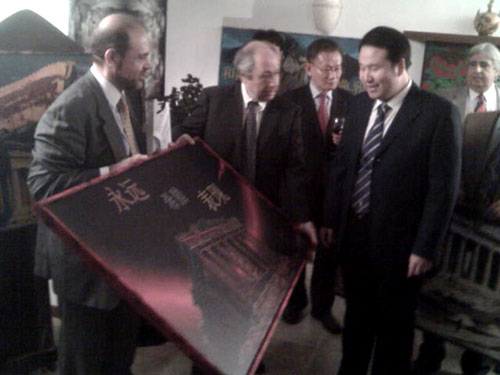
The Greek ambassador to China (middle) leapt on this exhibit as an opportunity to fawn over useful connections in Beijing. Here he presents a painting from the exhibit to the head of the Ministry of Something-to-do-with-The-Arts-which-I-didn’t-quite-catch.
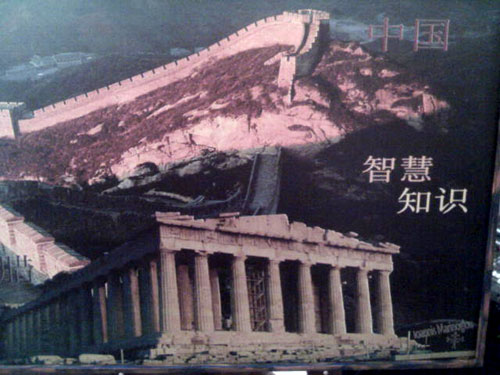
A typical example of the paintings on display. Maybe I’m a pretentious git, but I find this atrocious. The Chinese characters read “Greece” … “China” … “wisdom” … “knowledge”. The symbol next to the artists’ name bottom right is of his star sign, Uranus.
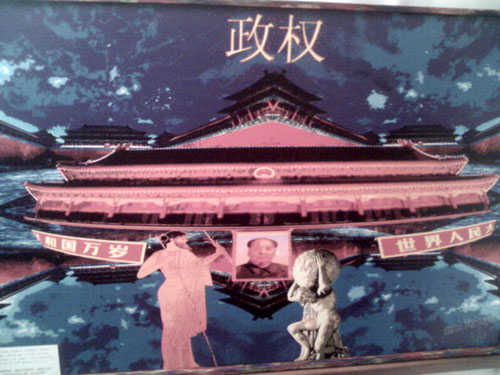
Zheng quan: “political power”. But what really, I mean, really, do Mao, Zeus (is that Zeus on the left?) and Atlas have in common? Outside of Mao’s imagination, and the concept of ‘pandering’, that is.
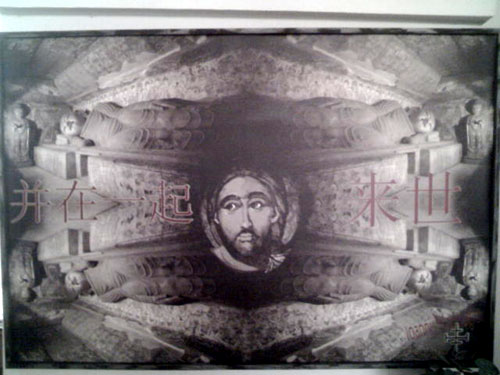
My personal favourite: Jesus’ disembodied head floating in the middle of four trippy-mirror-effect sleeping Buddhas*. The text on the left: “merge(d) together”; and on the right: “the afterlife”. Deep.
Happy Mooncake day all … how fast these festivals come and go. The PRC’s 60th birthday was only two days ago and already the nation has moved onto the excessive gifting of odd-tasting pastry. There’s probably a relevant Chinese saying which I could quote here – but I won’t.
On national day, I took a morning bus  (on gloriously empty streets) to Peking University or ‘Beida’ to watch the televised celebrations with students. If you’re after the parade itself, have a look at this wonderful 4 minute time-lapse and slow-mo version by Dan Chung of the Guardian.
As a Brit I have a inborn loathing of jingoism, which was rife in the parade itself. Patriotism is OK, however, and it was this that the Beida students were displaying – more than I had ever seen them show, including in the aftermath of a successful Olympics (the ping pong was all in Beida’s gym).
Below I’ll split up what I witnessed into a few liberally captioned photos. First, I asked each of the six characters I follow on this blog what they were doing and how they felt on this big day (as we know, any number like ‘6’ or 60′ is auspicious in China, so this national day was particulary special).
Tony … was watching the parade with me. He’d been one of the school kids in the 1999 fifty year anniversary parade, and seemed a little cynical of the eerily similar pomp and circumstance this time around. As ever he took pleasure in pointing out the politically significant bits, like how outside the limelight Xi Jinping was in the whole affair – a potential sign of his guessed-at leadership of China from 2012 being postponed, possibly forever.
Leonidas … got into Beida’s auditorium for the showing there (more below). When I then met up with him for noodles, he was clutching a Chinese flag and said he was almost moved to tears by the parade. This from a guy who’s head, in my experience, generally tends to be off in the clouds of classical Chinese literature more than it is on the ground of contemporary China.
Marie … was watching the internet stream in her dorm with her flatmates – one of whom was still sleeping from all the homework she was up late last night doing, even in this week-long national holiday. Earlier, I’d read a corny line in a Chinese paper: “today is your birthday too”. I’d sent Marie a text jokingly asking if this was true. I felt bad at my whimsy when she seriously replied “yes, today is also like my birthday”.
Matilda … was at a friend’s wedding, who’d evidently chosen this day as a lucky one to start a marriage on (modern China: unified until death do us part?). She texted me: “China is five thousand years old, new China is sixty years old. Let’s together wish new China prosperity!”
William … reinforced the message: “today is new China’s birthday”. New China (xin zhongguo)Â is a term much bandied about, claimed by the May Fourth movement as well as Sun Yatsen or the CCP (potentially by the reform and opening up era too). Normally, I’m never quite sure ‘new China’ is whose. Today, for young Chinese, new China was all Hu’s.
[groan] And finally,
Ben … was sleeping in, but with the TV on in the background.
Now for the day itself:
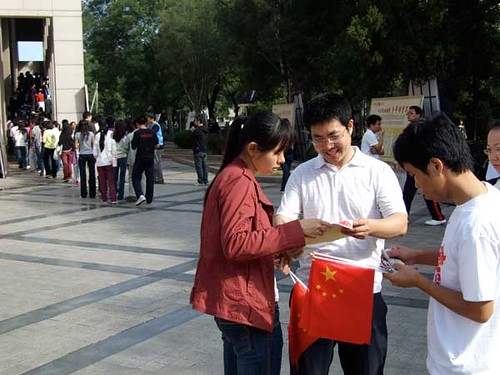
This guy far-right had sold forty or so flags by 9aï½. Behind them, Beida students line up for the screening of the parade on the big cinema screen in campus. They’d got their free tickets three days ago by queuing for (hear-say alert!) nearly 2km. Leonidas told me all of the students at this screening  stood up to give Hu Jintao an ovation.
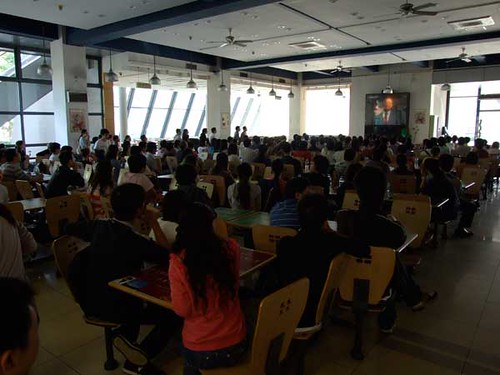
Tony and I most certainly did not queue for 2km, and so we watched the event in a neighbouring canteen – on a decidedly inferior screen with a fuzzy top-left panel which made Jiang Zemin look like a gremlin. There was a big laugh when Hu smiled upon seeing the troupe of female soldiers in high red skirts goose-step by. I got the impression here that most students were enjoying the fun of a big parade more than being overwhelmed with love of their country. And when the canteen started serving food – an hour before the parade was over – everyone was suddenly much more interested in lunch.

Zhongguo jiayou! Go China! If this were England, by the way, this picture could only mean one thing: these students had been watching a football or rugby game, not a military parade.
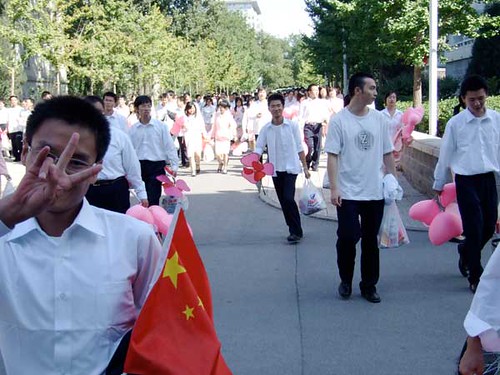
A contingent of Beida students took part in the parade, wafting symbolic pink wind fans (you can see them at 3:10 in the video I link to near the top of this post). Here they are, having been shipped back to their campus by giant buses, still pumped – despite having got out of bed at 2:30am to head down to Tiananmen square, and after a summer of compulsory training sessions two or three times a week.
Leonidas, in addition to his Chinese and ancient Greek names, has a new title: Minister of Life. He has held this most responsible of positions since the beginning of the new term at Beida last week. His colleagues include the Minister of Propaganda, the Minister of Academia, and, not to forget, their grand leader the Minister of the Ministers.
Leonidas claims that this clandestine organisation is merely a free society for students of the college of teaching Chinese as a foreign language at Beida, like him and Matilda. As Minister of Life, his duties are to help students buy their train tickets, organise daytrips to the summer palace and so forth. The Minister of Academia invites professors to give speeches. The Minister of Propaganda, allegedly, glues posters to walls. Every subject has its own society (xueshenghui) like this, with new Ministers chosen after interviews at the beginning of the school year.
But I don’t believe a word of it. Leonidas invited me to sit in on one of these interviews last Friday, after we had dinner together. But no sooner had we got inside were we met by the dreaded Minister of Ministers, who turned out to be a rather fierce girl in knee-high leather boots. “The interview is a formal interview”, she told me, “I’m sorry I’m sorry you cannot attend.” I didn’t want to wait until the burly security guards came for me, so I left.
Why such secrecy? What possible answer could there be other than that this supposedly innocuous organisation is a secret society, dedicated to such evil ends that I can’t even imagine? And what other Ministers are there? Their leader wouldn’t even tell me what position was being interviewed for – Leonidas didn’t know himself. Minister of Subversion? Minister of Secrecy? Minister of … Torture?
I took this photo through the window:

The brain drain (China’s best and brightest being lured by life overseas) is still one of China’s biggest problems – that Guardian piece by Jonathan Watts cites a study saying 7 out of 10 Chinese studying overseas don’t come back. So I’ll choose to politely ignore the Folex-hawking China Daily which declared the drain “reversed” back in 2003.
Well, Leonidas is one of the brightest Beida students I know, and he hopes to take a PhD in America, possibly 5 years in Linguistics or a related field. So I asked him – though not in such alarmingly medical phrasing – if he thinks his brain will be drained.
For one, his reasons for wanting to study in the US are different to those of a parallel Leonidas twenty years ago might have been. He simply wants to open his eyes and see what America is like. Just why I came to China. And, like me too (though the jury’s still out…), he wants to “seek a foreign experience but not a different lifestyle forever”.
With China’s growth and the question-marks floating over the Western hemisphere in the wake of the economic crisis, it’s an obvious point that there’s less incentive for Chinese to abandon ship. Their ship is sailing just fine. An obvious point … which Leonidas didn’t make:
Those who go to live in America give up much: fathers, mothers, friends, memories. To go to America is to restart everything. The cost is very high.
Too high for him? Seems so:
I can’t give up what I have in China. I can’t imagine beginning a new life in the USA. If I begin a new life, I don’t know if I can be accustomed to it … After all, I have spent almost 20 years education in a Chinese culture and atmosphere. So I think I have a different cultural system with America. This is too big a problem if I live there forever.
That’s one quote in a shouting shop. Some anectodal evidence for you (what else would you except from a lowly blogger?). Leonidas still thinks the brain drain is a big problem, and so do I. But we both think things are changing quick. Right now, I’m studying in a university way off the top ten lists (50 in the Times list last year). Watch this space 40 years on. (Check in 10 too.)
|
|