Here we are, June 4th, again. The first thing to say, to Chinese readers, is that we will not forget those who died on the night of June 3rd, 1989 … and nor do we apologise for keep bringing it up. On Danwei I’ve written a piece comparing the class of ’89 with the class of 2010 in Peking University, if you’re curious – but that’s not the meat of this post.
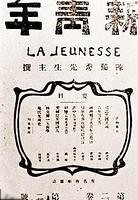
This is an essay I wrote for my Chinese language school in Beijing, IUP, as my end-of-term exam. My teacher and I had been looking at Chen Duxiu‘s essays in the early [20th] century magazine New Youth. Here I look at one essay in particular, in which Chen appeals to China’s youth to stand up, and tie it briefly to both the May 4th movement and 1989 demonstrations. I thought I’d publish it here – feel free to pick holes in my Chinese!
On September 15th, 1915, in the opening essay of New Youth magazine, Chen Duxiu writes:
“Youth are like the early spring, like the morning sun, like the blooming grass, like the sharp blade fresh off the grinding stone; youth is the most valuable time of life.”
Mr Chen, you’re too kind. I’ll do my best to treasure this valuable time – to use the opportunity when my blade is at its sharpest, when my sun is at its brightest, to analyse and shed light on what you write.
First off, I was wrong: in 1915 the magazine was still called Youth. It changed its name to New Youth in 1916, due to another magazine having the same name. If only changing the nature of youth was as easy as changing a magazine name. For what Chen Duxiu was striving for was precisely a new generation of young people – a generation willing to struggle and break down the old modes of thought. In the essay I mention above, ‘Advice [literally warning] for youth,’ Chen’s metaphor for the youth who oppose Confucian teachings, concepts of ritual, chastity, even the very ‘essence of China’, is “fresh, vigourous cells inside the human body”, and he compares old people who support the old theories and politics to rotten cells.
In this so-called ‘metabolism’ of society, he continues, these “rotten, corrupted cells at all times, by the process of natural selection, give space to stand and time to live in to the fresh, vigourous cells”. However this “natural” process, it seems, still needs a little human help: Chen appeals to the youth to “vigourously drive out those rotten, corrupted cells”. If “their blade is sharp enough to cut iron and hemp, [and they] don’t follow other’s lead or hesitate in thought”, then “maybe society will arrive at a peaceful day”.
Did society arrive at this peaceful day after all?
On May 4th, 1919, students (led by Beida students) gathered on Tiananmen square. The reason: the Chinese government’s weak reaction to the Versailles treaty. The result: the government of the time lost all credibility. That day was the ‘high tide’ of the May Fourth movement, a day with a deep impact on China – China’s youth had stood up. Thirty years of chaos and civil war later, the day Chen Duxiu strove for had (maybe) arrived: 1st October, 1949. But Chen couldn’t enjoy that day: for one, he died in 1942, but he had also split paths in 1929 with the Communist Party he formerly supported so strongly (we can see his discontent in this essay).
Supposing Mr Chen was still alive in 1949, I think he still wouldn’t have believed the day he sought had arrived. Because his attitude in ‘Advice to youth’ was rather pessimistic: even if the youth seem to be strong, if you “knock on their heads to see what they think and believe in, there’s not one who isn’t of the same ilk as those rotten, corrupted cells”. Even more so, he had no belief in his own search, his own appeal: “to find a few fresh, vigourous cells, to ease the blocked airway of my despair, is so distant [a prospect] as to be unnattainable”. However it wasn’t just the events of 1919 that proved him wrong …
On May 4th, 1989, students (once more led by Beida students) again gathered on Tiananmen square. This time, the reason was to commemorate Hu Yaobang, but it swiftly turned into a large-scale political movement. The result: according to conservative estimates, more than two hundred students were killed on the night of June 3rd. These young people, just like those of seventy years ago, were opposing the ‘elements’ that were “blocking the airway of society”, but the difference is rather paradoxical: this time, they were opposing the very Communist Party who before had opposed old modes of thought.
Chen Duxiu asks the reader: “The society of my country, will it prosper? Or is it doomed?” His opinion seems to be the latter. I say to the reader: don’t mind him. Although China, even today, still has many problems, none of them are incurable. To “cure this disease”, Chen writes, society must have “one or two youths sensitive enough to realise their potential, and brave enough to struggle”. The “disease” he talks of isn’t the disease of today’s society, but the prescription is just the same: new youth.*
___
* It’s rather weird, and bloody awkward, to translate something you’ve written yourself into your mother tongue. I’ve taken liberties, but hope the original author won’t mind.
Jetlag and sleep deprivation are both powerful forces of slumber, but neither could make me sleep through the combination on lantern festival of firecrackers marking the 15th day of the new year, and my cat’s equally loud excitement at my return to Beijing. (My picture of this – the lantern festival, that is – up on China Beat tomorrowtoday.)
Now I’m back in class, and as before I will fill the cracks in my wall of homework with blogging on the Chinese youth on and around the campuses of Peking and Tsinghua universities – following six stories from the generation that will change China.
It seems an appropriate preface on both study and blogging fronts to translate an essay I read recently in my Chinese textbook: “University students’ sense of responsibility” (大å¦ç”Ÿçš„责任感), a 1978 essay by Zhang Yifan, taken from Man and Society (人与社会) magazine.
I’m doing this, to be clear from the outset, because I think it’s a load of utter tosh.
Here’s Zhang’s opening (after a lame apology that his isn’t an “objective” study):
I find that at present many university students lack a sense of responsibility, can’t be certain of their own part to play in society, and consequently lack the strength to make progress.
For the majority of students, he goes on, their “attitude to study is for the most part extremely passive”; those with a positive study attitude are truly rare (凤毛麟角 – as rare as a phoenix feather or unicorn horn). Or to be specific:
They study not because of their own interest, nor to improve themselves, but only to get academic credit and eventually a diploma … their only concern is to find a relatively good career.
That’s a criticism of Chinese students by older generations (this is an assumption – I think a pretty safe one – that Zhang is older) that I also hear today. Students are irresponsible: they don’t care about their studies, they only think about their CV.
That may be well and true for many (and not only in China, by the way). But can we stick with ‘many’, in that case, and leave the pronoun ‘they’ out of it? Please don’t go moaning about the ‘quality’ of Chinese students (their suzhi ç´ è´¨ – a word I’ve never liked), as Zhang does, as if you can sum up a generation in an adjective.
What Zhang does have going for his diatribe is that the system gets an earful too:
education is almost entirely aimed at [getting students through] the two narrow doors of gaokao and zhongkao [middle and high school exams].
The education students receive before college, Zhang writes, is all about ‘cramming’ (å¡«é¸å¼ – a wonderful phrase, literally ‘force-feeding a duck’). And the prevailing atmosphere is of å‡å¦ä¸»ä¹‰ – a more clumsy to translate ‘philosophy of advancing up the education ladder’. Zhang goes on:
Once they’ve gotten into university, there’s no need for another gaokao, all their pressure suddenly eases, and the only goal which attracted them before and encouraged their effort disappears with it.
Students are equally mindless, we gather, when they come out of college:
To many graduates who intend to continue studying abroad, I ask them what their career aims are? Why are they taking graduate study abroad? The majority are at a loss, they don’t know how to answer, they only know they must get a PhD or master’s degree and then think again.
Again, there’s a grain of truth in this. When I showed Tony this essay, he said that the above rings a bell when it comes to many of his classmates. But Tony himself is an example of a soon-to-graduate student with a very clear goal for study abroad. In my experience (albeit at two elite universities), there are as many exceptions as ‘rules’. And … dare I say it … are young people not allowed to be uncertain about their future?
My objection to Zhang isn’t that he’s all wrong: it’s that it’s all too easy to lump Chinese youth into one category, blaming the suzhi of “irresponsible” students without any sympathy, and with only a cursory look at the root education environment. (This said, Zhang does blame schools for neglecting moral education – deyu 德育 – and family heads for only wanting their kids to get into a famous school.)
For me, the final straw was this bitter beauty of a whine:
[Students are] extremely self-centered. You only need to observe carefully, and it isn’t hard to discover that among those chatting loudly in public places, or cutting queues, many are university students. … [they] constantly raise requests, but infrequently express gratitude. … [they] are only concerned with their own interests, and don’t know how to respect and thank others.
Quite frankly, when I read that shopping-list of complaints, my mind leapt to older generations of Chinese: the loud businessman with his mobile on the subway, the taxi-driver spitting out the window, that kind of thing. I also think of the film Grumpy Old Men, and the phrase “kids these days…”. I guess: each to his own stereotype.
Of course, this post is a little spurious: it’s a 1978 essay, after all. (Which begs the question: on what basis what Zhang writing this thing, anyway? Universities only just opened again in 1978, after the college wastelands of the Cultural Revolution.)
So forgive me for falling into the same trap as Zhang did, and mouthing off. But I hear it all too often: Chinese students today only care about themselves. That’s why I enjoyed this reminder that there’s nothing new under the sun – or at least that past generations grumbling about the irresponsible youth of today certainly isn’t.
Exhibit A: here’s a member of more-or-less exactly the generation Zhang is talking about – also, to polish off the irony, surnamed Zhang – who has grown up only to complain in turn about the next generation (for those behind the firewall: Zhang Shihe, 56, quoted calling students today “the stupid generation”), thirty years on.
To no one’s surprise, there’s nothing more than a quiet breeze on the campus of Peking University twenty years after hundreds of its students were killed. To mark the occasion, a few quick thoughts on the back of a year studying Chinese in Beida (short-hand for PKU) as a foreign student:
What strikes me in terms of students speaking out openly is the absence not only of the anti-authority voices which identified their predecessors twenty years ago, but the absence of any kind of open engagement with contemporary politics that you expect in a top university, and see in universities everywhere else in the world. Their silence over the Sun Dongdong incident on their own campus is a good example (I blogged about it here).
It’s not just that they know their futures will be better served in a stable political environment and they have more to lose than previous generations (the obvious point). It’s that the majority has an iron belief in the current administration as working successfully to give them a better life. And it was talking with students on May 4th which made it clear to me the extent to which their priorities have changed from patriotism to individualism.
This all isn’t to say, of course, that there’s no kind of political discussion going on about the “incident” in Beida. There’s a lot. It just isn’t out in the open air for the world – and it’s reporters – to witness. It’s in quiet dorms and crowded canteens. I think the angle of students being intimidated into silence is wildly overplayed in some of the Western media (not to name names or anything). Yes, students are acutely aware of the risks of speaking up, but our press should stop feeding the misconception that China is something out of ‘1984’ where 1989 is concerned.
There is a very clear control in China over information about what happened twenty years ago last night (James Fallows discusses this on his blog). As Leonidas put it to me, “sometimes a student won’t talk about it not because he doesn’t want to, but because he doesn’t know about it”. Tony, on the other hand, dismissed off-hand the idea that Beida students are in the dark: information seeps easily enough onto the internet.
But it’s apparent that their dorm discussions are in a different ballpark to those of their counterparts two decades ago. While democracy is still an appealing model, Western ideas no longer hold sway for them purely on merit of being Western. Most consider themselves less naive than their predecessors, and believe that radical reform or protesting simply isn’t the way to fix China’s problems – just as some think of their futures as brighter for the failure of 1989 and the economic miracle which followed it.
All in all, two points: PKU today is as far from 1989 as it is from Orwell’s 1984. I’ll leave the final words with Tony on how fast the game is changing:
I recognise that the government now just does not want to mention [the incident], only to escape from it. … Ten years in the future [they] will probably just need to publish a conclusion on the 80s, mentioning ‘something really bad in 1989, which was the only choice we could take’. And then the problem is over.
My thoughts go out to the families of those who were killed that day. We will not forget it.
*
P.S. While I’m on topic, Tony tells me from a friend of his doing an internship with CNN Beijing that CNN will be coming onto PKU campus today to conduct interviews with students. What exactly do they expect the students to say? Surely not anything … oh I don’t know, mildly interesting? Expect lots of Communist Youth League members smiling into camera.
And to those kind folks who have recently blocked Twitter and Flickr in China: besides my twitter-box top-left, I use Flickr to display all photos on this blog, now invisible to anyone in China without a proxy until I move them. I see you are branching out into web design, internet police. Thanks for your constructive criticism: I really did need more white space.
The China Digital Times has picked up on a little story which caught my eye, given that it relates to my old university. Bo Guagua, the son of Bo Xilai (a high-ranking party official), studies at Oxford and has scooped a spot in 2009’s top ten “outstanding” young Chinese in Britain: the curiously named Big Ben award. Read CDT’s posts here and here (they’re blocked in China if you never got that proxy for Christmas).
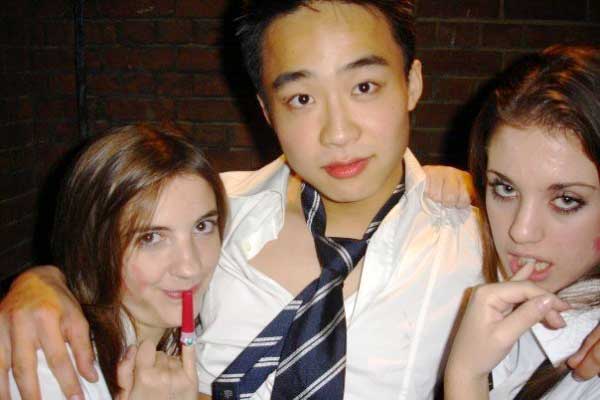
Now I’m as much a fan of CDT as the next China-watcher who wants 17 unread RSS items a day reminding him of how much CDT’s editors hate China’s government. But I thought it was a little unfair to portray Bo Guagua – in my eyes – as an undeserving playboy, through publishing a handful of (obviously facebook) pictures of him in that first link (see below) with no more in prelude than “while a series of photos of Bo the younger have become hot items in the Chinese blogosphere”. (In which case, by the way, I’d love to see this topic on chinaSMACK…)
I know CDT is only passing on the internet word here: I’m not criticising them but the online trend of hand-picking facebook pictures to ‘represent’ a life. It’s lazy. It’s not representative (of course facebook pictures are party pictures! how many photos of yourself studying alone in your room have you put on the internet?!). Most of all, it’s pissing young people off. And we may be deciding the rate of your pension scheme one day.
There is a lot of discussion going on these days as to whether netizens (be it bloggers, tweeters or BBS-ers) can fill the ever growing journalism gap as more and more papers will fold. I sincerely hope they can. Well, one way to win over the disbelievers is for no netizen to be so sloppy as to use facebook pictures like that.
And for the record: I believe it’s clear from his accomplishments listed the second CDT link I gave that Bo Guagua deserved this award. I didn’t know him at Oxford, but I emailed a friend who did. He replied:
From what I knew of him , he was very hard working, loyal to his friends, and – to your question – absolutely entrepreneurial enough to win such an award. I agree with you – the photos do him a disservice. We’re going to see more of this misuse of facebook photos in years to come as we, the first facebook generation, grow up and step into the real world. I don’t think people have fully thought through the consequences.
Too true. Well *yawn* it’s late, I’m off to … bed. That’s right, bed. I won’t be hurriedly deleting any of my old facebook pictures at all. Comfy bed.
Along with the great honour, the material award for winning the prestigious Big Ben award is a couple of brunettes in lipstick
Note: If you can’t see some of the above pictures, it’s because they’re on Flickr, which has just been blocked in China.
Beida students arrested in the aftermath of the May 4th protests, 1919
It being the 90th anniversary of the May 4th uprising, I spent my lunchtime today sitting in the heat on Beida’s (PKU’s nickname) campus, chatting with students to see if they felt May 4th spirit was still alive in Beida today. I arrived just in time to see two men on a ladder unfurl – with distinct lack of pomp and circumstance – a banner reading, in Chinese, ‘Peking University commemorates the May Fourth movement’s 90th anniversary’. Besides them and a dozen lazing security guards, noone seemed to care.
Here are two representative comments from a young guy and girl (respectively) I talked with:
“Nowadays, students want to earn a lot of money, live a better life … gain knowledge to make themselves famous and rich. They’re not concerned too much for their country. Now society’s advantage is in harmony with individual advantage. If they fight for themselves maybe they will also benefit society.”
“Now, on the one hand because of economic development, on the other hand because of control of speech and failure in 1989, college students pay less attention to politics, are more individualistic, and pay more attention to their own career … I think [May Fourth] should be celebrated more publicly, but it is treated with indifference.”
This, remember, is the very campus where the May 4th movement was born (we won’t let technicalities like the fact that the university switched location from downtown Beijing to the far North-West in 1952 bother us, right?). Beida students – even a brief stay here backs up their self-diagnosis above – have changed from the likes which produced the politically outspoken activists of 1919 (as in the picture) and 1989. There is more to lose than ever before from shouting, more to gain from silence. The class of ’09 will be changing China from within its system, not from outside it with a banner in their hands.
I interviewed Chris Patten on China and the Olympics, a couple of months ago in Oxford. For those of you who accidentally superglued a blindfold and earmuffs on your face as a child, Chris Patten was governor of Hong Kong until the handover in 1997. His book ‘East and West’ is well worth a read.
After the jump is a Chinese translation. Keep reading 6 for more like this.
Kind thanks to my friend Wang Yao for the following translation.
___
Chris Patten also tells me about his first sight of China, here.
And here are links to the other interviews I filmed in Oxford: