|
That’s the line from James Hilton’s 1933 novel Lost Horizon, from where the term ‘Shangri La’ originates:
Seeing it first, it might have been a vision fluttering out of that solitary rhythm in which lack of oxygen had encompassed all his faculties … A group of coloured pavilions clung to the mountainside with none of the grim deliberation of a Rhineland castle, but rather with the chance delicacy of flower petals impaled upon a crag. It was superb and exquisite.
I’m reading the book in Zhongdian, Yunnan – renamed ‘Shangri La’ in 2001 to pull in the tourists. It’s one of several places to claim the name: others are Tibet’s Kun Lun mountains, northern Pakistan, and as far as I can tell pretty much all of Bhutan. All, needless to say, are pretty damn clearly marked on any map.
And as to the Shangri La I’m in (unless lack of oxygen has encompassed all my blogging faculties), I’ve yet to see any delicate flower petal pavilions clinging to the mountainside. I can, however, choose to stay in a hotel themed to look as such for 400 US dollars a night, before stopping in at the monastery, with it’s subway style ticket-swipe gates.
And so, after years of searching, travel worn and oxygen deprived, with only a Western style banana pancake for twenty yuan to comfort me, I have found China’s capitalist Shangri La.
Update: Most of the shop and hostel owners here seem to have heard of Hilton’s novel, if not read it or recognise the name. I learned from one of them, incidentally, that early twentieth century travels and writings of Joseph Rock in this corner of the world might have inspired the novel.
From the middle of my exams, a few final bullet points to wrap up June 4th – for those who aren’t fed up to the teeth with the whole umbrella-d business, that is.
- I made no mention earlier of the atmosphere walking around the Beida campus on the big day itself. Well, it was an odd combination of edginess and nonchalance. The edginess came in the form of uniformed police officers circling campus on mopeds (but I only saw a couple, and there was no added security on the gates as far as I could tell). The nonchalance was the utter lack of anything for the police to be policing (despite or because of their presence is another debate – and one already purple with clicked links). I can’t quite make my mind up into which of the two categories the security personnel pictures below fit into: the pair of them were leisurely circling Beida’s infamous ‘triangle’ (the open space on campus where the 1989 students first gathering before moving downtown) all day on their pedal bikes. It was a beautiful summer day, and I would have enjoyed the exercise too.
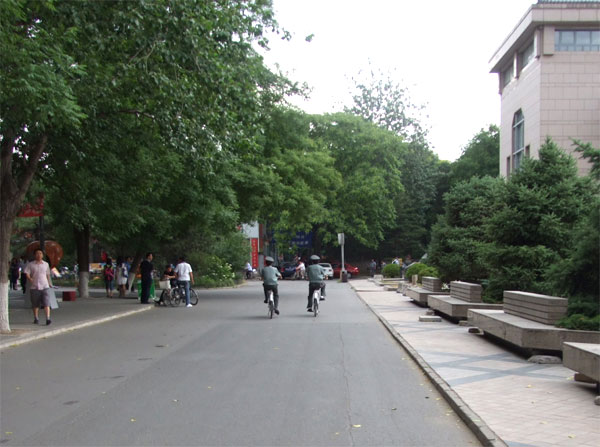
- To illustrate a point often made that the memory of June 4th is swiftly fading in China’s new generations: I happened to be having a coffee with Matilda that day. After a long chat about other things, I mentioned the occasion. Silence. Errr… blank look. I’m not helping. More awkward blank look. Finally: “Oh yes! I’d completely forgotten that was today”. The generation before, however, needs no jogging. Both my Chinese teacher and the teacher of a friend raised the topics themselves (in a one-on-one and in class respectively), and – albeit in couched terms and swiftly moving on – mentioned how excessive they felt the police action had been this time.
- I just got this email*, in reaction to my earlier post, from the friend whose comments – along with Tony’s – I published in my post about the Sun Dongdong (non) protests:
Some distinguished scholars in China even told me that after one hundred years, people might compare [June 4th] and Deng [Xiaoping’s] reform and opening up with the Zhenguan reign in the Tang Dynasty. Remember both leaders made some tough decisions (they got their hands dirty but the situation forced them to do it that way in order to maintain the public good for the majority; try to understand it in an utilitarian way, too – for them, that is hard to accept but the true meaning of politics) but then initiated the most prosperous and open (comparatively speaking of course) times in Chinese history.
Right. Four anniversaries down, one to go. Then (whisper it) will Zhongnanhai finally tick the last stroke off on it’s giant red zheng and leave us all bloody f-ing alone?
___
* NB: with all the characters I follow on this blog, if they are speaking or writing to me in English I clean up any mistakes in their grammar and spelling before publishing. I’m careful not to change their meaning. Not necessary to mention, perhaps, but shoot me.
To no one’s surprise, there’s nothing more than a quiet breeze on the campus of Peking University twenty years after hundreds of its students were killed. To mark the occasion, a few quick thoughts on the back of a year studying Chinese in Beida (short-hand for PKU) as a foreign student:
- What strikes me in terms of students speaking out openly is the absence not only of the anti-authority voices which identified their predecessors twenty years ago, but the absence of any kind of open engagement with contemporary politics that you expect in a top university, and see in universities everywhere else in the world. Their silence over the Sun Dongdong incident on their own campus is a good example (I blogged about it here).
- It’s not just that they know their futures will be better served in a stable political environment and they have more to lose than previous generations (the obvious point). It’s that the majority has an iron belief in the current administration as working successfully to give them a better life. And it was talking with students on May 4th which made it clear to me the extent to which their priorities have changed from patriotism to individualism.
- This all isn’t to say, of course, that there’s no kind of political discussion going on about the “incident” in Beida. There’s a lot. It just isn’t out in the open air for the world – and it’s reporters – to witness. It’s in quiet dorms and crowded canteens. I think the angle of students being intimidated into silence is wildly overplayed in some of the Western media (not to name names or anything). Yes, students are acutely aware of the risks of speaking up, but our press should stop feeding the misconception that China is something out of ‘1984’ where 1989 is concerned.
- There is a very clear control in China over information about what happened twenty years ago last night (James Fallows discusses this on his blog). As Leonidas put it to me, “sometimes a student won’t talk about it not because he doesn’t want to, but because he doesn’t know about it”. Tony, on the other hand, dismissed off-hand the idea that Beida students are in the dark: information seeps easily enough onto the internet.
- But it’s apparent that their dorm discussions are in a different ballpark to those of their counterparts two decades ago. While democracy is still an appealing model, Western ideas no longer hold sway for them purely on merit of being Western. Most consider themselves less naive than their predecessors, and believe that radical reform or protesting simply isn’t the way to fix China’s problems – just as some think of their futures as brighter for the failure of 1989 and the economic miracle which followed it.
All in all, two points: PKU today is as far from 1989 as it is from Orwell’s 1984. I’ll leave the final words with Tony on how fast the game is changing:
I recognise that the government now just does not want to mention [the incident], only to escape from it. … Ten years in the future [they] will probably just need to publish a conclusion on the 80s, mentioning ‘something really bad in 1989, which was the only choice we could take’. And then the problem is over.
My thoughts go out to the families of those who were killed that day. We will not forget it.
*
P.S. While I’m on topic, Tony tells me from a friend of his doing an internship with CNN Beijing that CNN will be coming onto PKU campus today to conduct interviews with students. What exactly do they expect the students to say? Surely not anything … oh I don’t know, mildly interesting? Expect lots of Communist Youth League members smiling into camera.
And to those kind folks who have recently blocked Twitter and Flickr in China: besides my twitter-box top-left, I use Flickr to display all photos on this blog, now invisible to anyone in China without a proxy until I move them. I see you are branching out into web design, internet police. Thanks for your constructive criticism: I really did need more white space.
Here’s another bone I have to pick with the recent NY Times article on today’s generation of students at Peking University. It claims in its first paragraph that all 32,630 student’s mobiles received a text message in the run up to May 4th warning to “pay attention to your speech and behavior” that day, given the sensitivity of this year. Well, Tony and other students I know have told me that they and their friends they received no such text.
So, make that 32,630 minus a dozen, Sharon laFraniere of the New York Times?
A more general gripe is that the article flits arbitrarily between two reasonings behind the apparent silence from students on the events of twenty years ago: 1) they are too scared of the consequences of speaking up in an oppressive environment and 2) their generation is too far removed from the event to care, especially given their more utilitarian ‘me first’ priorities. Sure, both reasons come into play. But I get a distinct sense that this article simply can’t make its mind up between the two. And it completely misses the fact that Beida students do discuss ’89 – in their dorms, and even in class with their teachers, I have it from students themselves. Obviously less so on record with reporters.
Well, that’s my beef in an otherwise thoroughly-researched piece. And I can’t help but thinking that if hyper-local blogging can call out big media names like the NY Times on little errors (like not every student received that text), then either those big names will have to incorporate that kind of citizen journalism into their news-gathering model, or see themselves called out time and time again until finally their readership goes elsewhere – and they lose that big name. (Incidentally, the New York Times forcing readers to register – try clicking on the link I gave – before reading a piece, instead of giving us the option, won’t help.) Jeff Jarvis is fun to follow on this theme.
The China Digital Times has picked up on a little story which caught my eye, given that it relates to my old university. Bo Guagua, the son of Bo Xilai (a high-ranking party official), studies at Oxford and has scooped a spot in 2009’s top ten “outstanding” young Chinese in Britain: the curiously named Big Ben award. Read CDT’s posts here and here (they’re blocked in China if you never got that proxy for Christmas).
Now I’m as much a fan of CDT as the next China-watcher who wants 17 unread RSS items a day reminding him of how much CDT’s editors hate China’s government. But I thought it was a little unfair to portray Bo Guagua – in my eyes – as an undeserving playboy, through publishing a handful of (obviously facebook) pictures of him in that first link (see below) with no more in prelude than “while a series of photos of Bo the younger have become hot items in the Chinese blogosphere”. (In which case, by the way, I’d love to see this topic on chinaSMACK…)
I know CDT is only passing on the internet word here: I’m not criticising them but the online trend of hand-picking facebook pictures to ‘represent’ a life. It’s lazy. It’s not representative (of course facebook pictures are party pictures! how many photos of yourself studying alone in your room have you put on the internet?!). Most of all, it’s pissing young people off. And we may be deciding the rate of your pension scheme one day.
There is a lot of discussion going on these days as to whether netizens (be it bloggers, tweeters or BBS-ers) can fill the ever growing journalism gap as more and more papers will fold. I sincerely hope they can. Well, one way to win over the disbelievers is for no netizen to be so sloppy as to use facebook pictures like that.
And for the record: I believe it’s clear from his accomplishments listed the second CDT link I gave that Bo Guagua deserved this award. I didn’t know him at Oxford, but I emailed a friend who did. He replied:
From what I knew of him , he was very hard working, loyal to his friends, and – to your question – absolutely entrepreneurial enough to win such an award. I agree with you – the photos do him a disservice. We’re going to see more of this misuse of facebook photos in years to come as we, the first facebook generation, grow up and step into the real world. I don’t think people have fully thought through the consequences.
Too true. Well *yawn* it’s late, I’m off to … bed. That’s right, bed. I won’t be hurriedly deleting any of my old facebook pictures at all. Comfy bed.

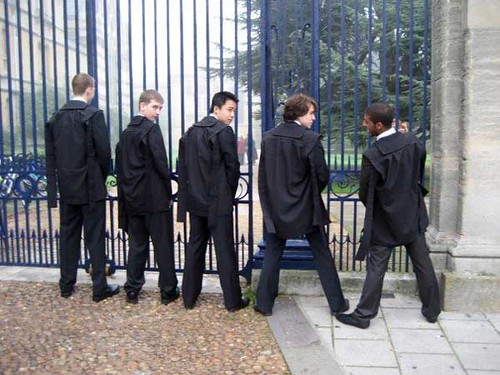
 Along with the great honour, the material award for winning the prestigious Big Ben award is a couple of brunettes in lipstick Note: If you can’t see some of the above pictures, it’s because they’re on Flickr, which has just been blocked in China.
The way out of the two holes the world finds itself in – its frozen economy and overheated climate – are for the time being mutually exclusive when it comes to talks with China. We need China’s economy to keep booming to help us pay our own bills, and we need it to slow down please before our environment is decimated by those dirty factories which are fueling that same economic boom.
This isn’t to say there won’t be a way to accommodate the two further down the line: commentators like Thomas Friedman think the biggest companies of this century, digging us out of our financial hole, will be the green energy companies which are also working on the ecological one. But for the time being, not polluting is expensive – much too expensive for a government like China’s, which needs its economy to keep growing to legitimise its rule.
I keep thinking that the most immediate solution, without China having to endanger its economy to a point it will clearly not tolerate, is technology transfer – the West giving away clean technology secrets to countries like China (which either can’t or won’t foot the R&D bills themselves). That’s certainly what William would like to see: he gets very excited at the mention of technology transfer, but is concerned that China’s terrible record on IP protection will prevent American companies from playing ball.
In the midst of these economic and environmental crises, I see ten articles or commentaries on the former for every one I see on the latter. In a lot of them, there is reference to ‘future generations’, ‘for our children’ etc. etc. (or take a look at the banners in yesterday’s US ‘tea-parties’). Well, I’m one of those future generations. And you know what I’d like the older generation to get mad about? Not my employment and pay-check prospects, but my prospects of living in a world not too unrecognisable from the one I enjoy living in now.
|
|