6


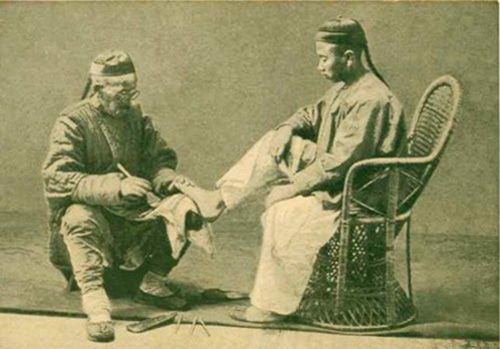
Exhibit A. Qing dynasty queue:

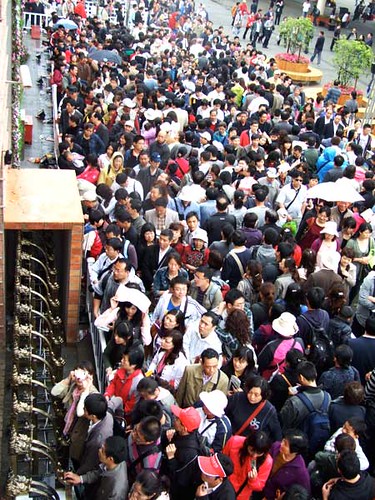
Exhibit B. Expo dynasty queue:

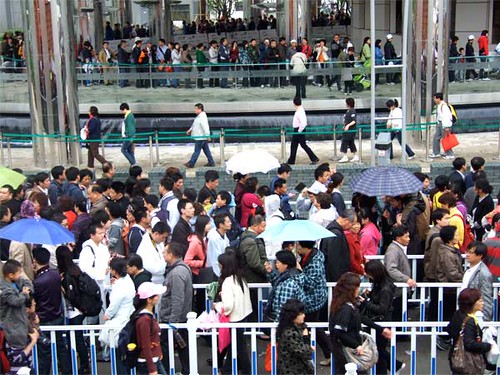
I took that second picture (I wish I could take credit for the first) a few days ago from atop the Indian pavilion of the Shanghai Expo. This queue took over an hour, which was nothing compared to the alleged 3+ hour queue for the neighbouring Saudi Arabian pavilion:

Given the choice between queues: I’d take the hairstyle.

My attempt at an answer is up on Danwei. I like the accidental (?) timing of this being published today, the 91th anniversary of May Fourth, when the attitudes of China’s new youth are on the minds of many. (Btw, I wrote about the 90th anniversary here.)

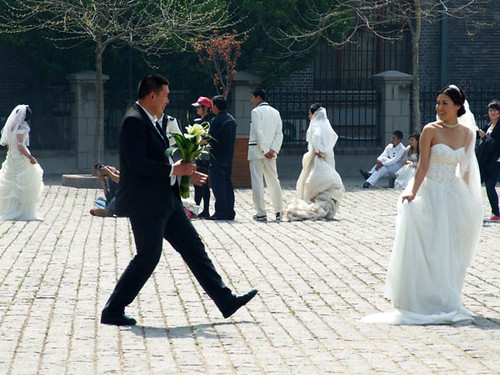
Spotted yesterday by St. Michael’s Cathedral in the port city of Qingdao: a Chinese applicant for the Ministry of Silly Walks. This is how to woo a lady. It clearly worked.

That afternoon, lazing on Qingdao’s accurately named ‘No. 1 Beach’, my friend counted how many girls we could see in wedding dresses, having their photos taken. (I don’t say ‘brides’, because it wasn’t necessarily their wedding day. Chinese wedding albums are lavish, expensive, Tolstoy thick affairs, around which a thriving industry has evolved, and which often take a whole day to shoot - sometimes long after the wedding itself.)

The final tally, all in one wide panorama: 21.

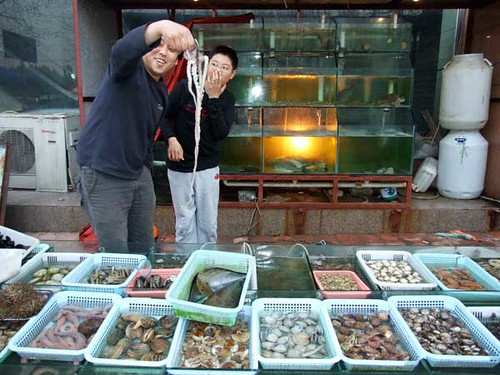
And the funeral? This poor octopus’s, who rests in peace in the ocean of my belly.

Marie’s job hunt, that is. At the beginning of the week, I got a call in the library from a rather panicky Marie. She had been called in at short notice to interview - in English - for the handbag firm Coach, and wanted a dry run of her self-introduction before her interview began in half an hour. At one point, a momentary confusion between the words ‘impress’ and ‘express’ resulted in what I thought was an accidentally brilliant summary of the fashion industry: “I want to work in fashion because fashion is how people impress themselves”.

Over a bite another night, Marie wasn’t hopeful: the interview had only lasted ten minutes, with Expo-worthy queues of applicants outside. She’s had six job interviews so far. And that very day, she took two maths exams - with more of both interviews and exams to come. Nor is the summer holidays any longer a light at the end of the tunnel: Marie hopes to begin work as soon as she graduates. It’s a hard knock life.

I told her over dinner of what Ben had done: strike it on his own with an online shop on Taobao. Ah yes, she responded: lots of Beida students do that in their free time - and made a fair profit off it. But as a full-time enterprise? She couldn’t imagine it. No security. She wanted two things for herself: a good job, and to be in the same town as her roommate and best friend. Which means disappointing her mum and dad, who - like all mums and dads - are encouraging her to take a job in her home province of Yunnan.

Another disappointment was that Marie didn’t get the job at the Japanese interior decoration company, Epco (see my earlier post linked at the top). Instead, they hired two boys. I asked if she thought there was anything sexist about their choice. No, she said, because “it is a technology job” - and boys are considered better at tech. Then she paused for a moment, as if the thought had just occurred to her: “but my subject is  also technology”. So isn’t choosing boys over girl sexist? A briefer pause. “Maybe.”

This is a guest post by Katrina Hamlin, who last year blogged, from Chengdu, the one year anniversary of the Wenchuan earthquake. Now, in the wake of the Yushu quake, she returns to the topic of youth involvement in relief efforts, interviewing (by email and Skype) her former students.

*

On 12th May 2009 I reported Chengdu students’ quiet but sincere response to the Sichuan disaster’s first anniversary. Walter Brown, manager at Sichuan Quake Relief, suggested that their concern and desire to help represented the growth of China’s civil society. He described children telling the world “I want to grow up to be a volunteer”. The earthquake had wrecked havoc in some of China’s poorest and most vulnerable communities, but something positive was emerging from the mess.

A desire to volunteer was strengthened by the Beijing Olympics. People were keen to play a part in hosting the games. It was an honour to be among the volunteers lending a hand, representing China. As a Brit I was repeatedly asked whether or not I would volunteer for the London Olympics. Many were shocked when I admitted that I simply wasn’t interested in the Olympics and might even be in China in 2012.

The government has also been investigating the possibilities. A number of think tanks are researching social innovation, and Beijing hosted an international conference examining the ways in which civil society can help development.

So I expected students and young people in Chengdu and elsewhere to pursue a growing interest in volunteering and the third sector. I thought that Qinghai’s quake would be another catalyst. It’s two weeks until the second anniversary of the 2008 quake in Sichuan, and the papers are full of Yushu’s tragedy. The Sichuanese are experiencing vivid deja vu. “Every time I heard earthquake it will remaind [sic] me of Sichuan,” wrote a student from Sichuan Normal University.

Qinghai’s disaster is smaller in scale than Sichuan’s but no less devastating for the individuals involved; and like the 2008 quake, it will be followed by another event that is a matter of national pride. Next month Shanghai will open the 2010 Expo. That doesn’t mean very much to my friends in England, but the festival has been eagerly anticipated in China. When I first visited the city in 2005 they already had a clock counting down the seconds until the opening. Like the Olympics, there’s an understanding that individual citizens can help show China in a positive light. Opportunities to influence the Expo’s success range from working the pavilions to breaking the age old habit of wandering downtown Shanghai in pyjamas.

I asked my former student Jasmine and some of her friends about their responses to the quakes, how they went about showing their sympathy and helping the victims. Jasmine herself lived through the Sichuan quake. She and two of the other participants were among those I interviewed on the quake’s first anniversary in 2009.

Some of them expressed a desire to be actively involved in relief work, and felt that wanting to be a volunteer was increasingly common.

If i have chance to be a volunteer or give my sympathy directly to the people here,i will help them without any hesitation - Voilet

I want to do more things to help them just as others helped me in 2008 - Demo

I would like to be a volunteer if I can ! … i think there will be more and more youth take part in volunteer jobs - Leon

…from my point of view,before the earthquake
and the Beijing Olympics,there are already many young people
wanted to contribute themself to something,but for some reasons,
like they don’t know what to do or have no determinations,these
two gave them a chance to find it out,they feel strongly that the
sociaty [sic] needs them’ - Moon

But this was not a universal reaction, and those who wanted to be involved foresaw problems. It is difficult to volunteer. After the Sichuan quake, the press and other organisations called for volunteers. This time, it is harder to find that kind of opportunity. If there is no organisation with which to volunteer, efforts may be futile and could even make things worse. China has ‘such a lot of good students, and such a lot of excellent people’ who would want to thrown themselves into voluntary work if given the chance. But if you let them get involved, there could be “some trouble”, Jasmine admitted; not everyone has the necessary expertise.

In a follow-up interview Jasmine added that there were additional problems. You could ask to volunteer with an organisation. But they would most probably ask for certain documents, or request that you go and register you interest at such and such an office, where you would be sent on to another office, and then another. An alternative would be to set up a team of volunteers of your own. But that wouldn’t be easy, they may also lack the necessary know-how, and in some circumstances it’s likely that it wouldn’t be allowed. As Jasmine summed up, “procedure will be complicated” for a would-be volunteer. She also pointed out that this earthquake, even coupled with the expo, would not push the voluntary movement forward (at least in Sichuan) because the tragedy in Qinghai is still dwarfed by Sichuan’s disaster.

The Sichuan quake also saw a great call for fundraising. Organizations and individuals gave generous donations of money and goods. But this time, things are different.

i can’t make sure if the money i donate will be used properly - Moon

about the money, I m not quite sure the all the money will be uesd [sic] where it should be - Leon

Scandals following dubious fundraising by public figures like Zhang Ziyi have caused some to lose faith in charitable giving. Others were still keen to donate, but Jasmine pointed out that unlike in 2008 there hadn’t been any requests for public donations in the media.

Civil society needs space and particular kinds of opportunities for good will to grow into something practical. In that sentence, I’m afraid the word ‘opportunities’ includes the disasters that provoke an acute desire to contribute something, anything, for the cause. In China, patriotism is also a greater motivation than it is elsewhere; “Smply,we love China!And China need us,” said Demo. But the structures and organisations needed to use these opportunities are still hard to find.

In the wake of the Yushu earthquake, solidarity and love of country is palpable. (Although for implications of the quake on Han-Tibetan relations, see this conversation with Robert Barnett on the China Beat.)

Another pretext for patriotism - not that China needs it - is the opening of the Shanghai World Fair in nine days. This amateur calligrapher, from Shanghai, is in the middle (that’s a really lame pun, if you know the character 中) of writing ‘Love My China’ on the streets of Hohhot.

Now, is that a shorthand statement, or polite request?

Love my country

___

PS - also up at the China Beat is the twin of this photo.

« Older entries § Newer entries »