|
A good question, I think, given that I’m writing about what Beida students are talking, thinking and learning about in those dorms. The answer? It looks like this:
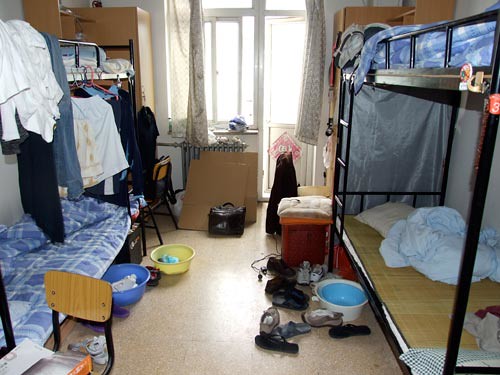
That’s a friend of mine’s dorm in Beida’s south-west corner. Here’s the corridor outside (the room with the flag on it is the room above, I’ve smudged the room number):

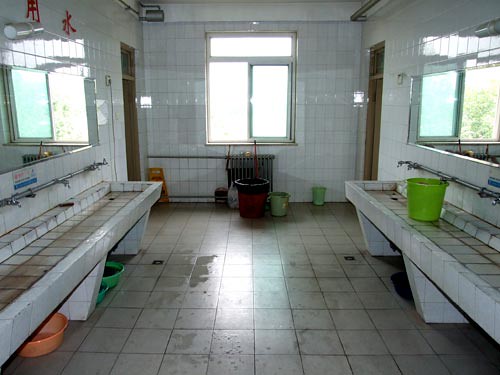
And the shared washroom, where many students handwash their laundry:
I also took a sneaky action shot from an open door a little way down the corridor, of three students, back to back, shirts off in the heat, working at their desks in a room similar – but smaller – than the one up top. It was a fun photo and I was thinking of publishing it, but my conscience got the better of me. Score: privacy 1 blog 0.
Given the spree of Taiwan-related content up of late (like this awkward moment over dinner), I asked my Taiwanese friend Xu Zhide (å¾è‡³å¾·) the other day if he’d be so kind as to write a guest post for Six. He was.
Zhide is back East for the summer, on break from his studies in London, where he’s writing his graduate thesis on relations between constituent parts of the UK and greater China (full title: ‘Too Many to Tango or Rebirth of Phoenix? Quasi-Asymmetric Federalism in the UK and Greater China’).
If a comparison to the UK-Scotland-Wales-Ireland mess situation seems a roundabout way to discuss mainland China-Taiwan-HK-etc., that’s because it has to be that way: Zhide is also an exchange student at Beida, and a direct approach simply isn’t on. But enough ado, here’s his post (I’ve edited his English for accuracy, being careful not to impact on meaning.)
•
If the question of whether ‘Taiwan is part of China’ is raised in mainland China, no matter if by a 3 or a 90 year old, the answer never differs, as l observed several years ago when l landed here for the first time.
Actually, even now, at least constitutionally, the ROC (Taiwan) claims her sovereignty over ‘whole China’, which is like saying ‘mainland China is part of China’. So a Taiwanese shouldn’t be so suprised that their counterparts in mainland China declare Taiwan to be part of (‘whole’) China as well.
Having said that, these kind of symbolic and self-assertive declarations are, of course, treated more seriously in the latter context, while obviously more lukewarmly in the former context, especially when Taiwanese consider themselves so unique/superior from/than ‘mainlanders’ (or ‘Chinese’) right now.
And this difference makes any conversation on their ‘special relationships’ run less smoothly most of the time, while most Taiwanese, in their daily lives, are also not so aware that the ‘magic power’ to prevent another round of civil war would simply depend on such a constitutional association.
So, some kind of ‘æ— æ‰€è°“’ [‘I really don’t care’] might be a good attitude to foster new relations between both sides in the beginning, as might also be the case in Europe, especially after 90’s.
And that is exactly what l found there recently, too.
Although my lovely classmates in Europe would argue seriously over the root of the current financial crisis, and show their preference of approach towards the remedy of it based on their ethnic backgrounds as differentiated by Anglo-Saxon or Latin, the chance of such a ‘currency war’ turning out to be the end of the Euro Zone, or even EU, is still too distant to tell.
After all, economically, they are so interrelated; emotionally, they are more friends than enemies. And a friend in need is a friend indeed.
Mainland Chinese are also eager to show similar [friendly] feelings towards residents in Taiwan recently, through ECFA and many other efforts.
And although Taiwanese continue to consider their relationship with ‘Chinese’ as more like partners in business, the strategic switch from ‘attacking’ to ‘buying’ Taiwanese in the CCP’s thinking is promising.
One ‘official’ think-tank member even speaks for his ‘boss’ and many others in saying that “the economy coming before politics is precisely politics in its cleverest form”.
It seems that some ‘normative power’ of the EU penetrates and echoes well even in the CCP’s mindset.
So l am pretty sure that our European friends like Alec would also welcome the recent trends happening across the Taiwan Straits. [Ed: sure!]
And although some kind of caution about ‘foreign nations intervening in affairs which are not their own’ is represented in Alec, he could still be proud that efforts at dialogue between cultures, or even civilizations, are also embodied in him: a Chinese-friendly European youth. [Ed: *blush*]
This is the third (and likely final) installment of translations from the facebook notes of a Taiwanese exchange student in Beijing. Read my preface of sorts to these translations, here.
In this note, Yi-jung’s visit to the old Summer Palace prompts some thinking about history teaching in Taiwan and mainland China.
•
A trip to the old Summer Palace (2010.12.3.2010)
I took the subway today from Peking University station to Yuanmingyuan station, and the old Summer Palace was right there.* Before, I’d only seen a picture of the old Summer Palace in my middle school history textbook, but now there’s a subway station next to it. I couldn’t believe that a hundred years ago, British and French troops destroyed this place, and maybe a lot of people died here. Even more difficult to imagine was that Qing dynasty emperors, eunuchs, concubines and courtiers had also walked on this land. This feeling is difficult to describe. At any rate, these people hadn’t gone to Taiwan.
Walking through the ruins of the European buildings, I saw lots of Western style architecture, but what I saw wasn’t authentic, but rather a simulated rebuilding. Then I walked into a maze. It was difficult to understand why so much effort was spent to build a maze like this, I really don’t know what the people of the time were thinking. According to my limited memory of history, the political situation of that time was chaotic, and the state of affairs worldwide had changed, but there were still people [i.e. the imperial court] who didn’t realise how explosive the times were.
Beijing is a city with a heavy history. However, I feel that these historical sites aren’t so important to the locals here, maybe [having them around is] as natural as breathing for them? I don’t understand why the history my middle school taught included mainland Chinese history in our national history**. If I was taught another version of history, maybe the meaning of this place to me would have decreased immensely.
•
去圓明園 2010-03-12
今天從北大æ±é–€åœ°éµç«™æ到了圓明園站出站後,就到了圓明園。以å‰åªæœ‰åœ¨åœ‹ä¸æ·å²èª²æœ¬çœ‹åˆ°åœ“明園的照片,ç¾åœ¨åœ“明園æ—就有了地éµç«™ã€‚我更難想åƒä¸€ç™¾å¤šå¹´å‰è‹±æ³•è¯è»ç ´å£žåœ“明園那副景象,å¯èƒ½é‚„有很多人æ»åœ¨é€™å…’ï¼æ›´é›£æƒ³åƒä»¥å‰æ¸…æœçš„皇å¸ã€å¤ªç›£ã€å¦ƒåã€å¤§è‡£ä¹Ÿæ›¾ç¶“走在這塊土地上,這種感覺,真的很難形容。至少,這些人是ä¸æœƒèµ°éŽå°ç£é‚£å¡ŠåœŸåœ°ä¸Šçš„。
走進了西洋樓éºå€ï¼Œçœ‹åˆ°è¨±å¤šè¥¿æ´‹çš„å»ºç¯‰é¢¨æ ¼ï¼Œä¸éŽçœ‹åˆ°çš„也ä¸æ˜¯çœŸè·¡ï¼Œæ˜¯ä¹‹å¾Œä»¿çœŸè·¡æ‰€å¾©å¥çš„。然後走到一個迷宮,很難ç†è§£ç‚ºä»€éº¼è¦èŠ±äº†é€™éº¼å¤šå·¥å¤«ï¼Œè¨è¨ˆäº†é€™æ¨£ä¸€å€‹çœŸäººè¿·å®®ï¼ŒçœŸä¸çŸ¥é“那時候的人在想什麼?據我有é™çš„æ·å²è¨˜æ†¶ï¼Œé‚£æ™‚候時局很亂,世界局勢改變,當時還是有人éŽè‘—ä¸é£Ÿäººé–“ç…™ç«çš„æ—¥å啊。
北京是個有著沉é‡æ·å²çš„城市。ä¸éŽé€™äº›æ·å²å¤è¹Ÿæ„Ÿè¦ºå¥½åƒä¹Ÿä¸æ˜¯é‚£éº¼å‚™å—這裡的人民é‡è¦–,å¯èƒ½å°±è·Ÿç©ºæ°£ä¸€æ¨£è‡ªç„¶å§ã€‚ä¸çŸ¥é“以å‰åœ‹ä¸æ·å²ç‚ºä»€éº¼æœ¬åœ‹æ·å²æœƒåŒ…å«ä¸åœ‹æ·å²ï¼Œå¦‚果我接å—的是å¦å¤–一套æ·å²æ•™æ,å¯èƒ½é€™å€‹åœ°æ–¹å°æˆ‘çš„æ„義,就會減少許多å§ã€‚
___
* ‘Yuanmingyuan’ is the Chinese name for the old Summer Palace. The Chinese means ‘garden of the full moon’ (correct me if I’ve got this wrong, readers).
** For ‘national history’, Yi-jung uses 本國æ·å², referring to the Republic of China (ä¸åŽæ°‘国) as her perspective is Taiwanese. The term I’ve translated (wrongly, but it helps to make the meaning clearer) as ‘mainland Chinese history’ is ä¸åœ‹æ·å², literally ‘Chinese history’. In her clarification email when I asked about these terms, Yi-jung writes that this term includes æ·ªé™·çš„å¤§é™¸åœ°å€ – ‘mainland [China] which fell into enemy hands’ (no kidding). All this give me a big headache, as it does Yi-jung. “I think that [本国] and [ä¸å›½] aren’t unequivocal terms”, she writes, “I’m not even clear about them myself. It’s an extremely complicated problem.” You got that right.
Two years ago, I interviewed Wang Yao, a Chinese journalist at China Youth Daily, who was then on a one year fellowship at the Reuters Institute for the Study of Journalism, in Oxford University. Now back in Beijing, Wang has become editor-in-chief of the paper’s website, China Youth Online (ä¸é’在线). China Youth Daily was not long ago praised by Bill Bishop at Sinocism for publishing a bold article (translated by China Geeks) on the housing crisis.
At the time of the interview, Wang was reluctant for me to publish. But I’ve just asked him again, and he’s fine with it now. When reading his comments, bear two things in mind: a) he was speaking in March 2008, and b) we were speaking in English, a language Wang wasn’t 100% comfortable in. I’ve corrected little grammatical errors which don’t impact on the meaning.
Although I find his first two responses below interesting counterfoils to Western views, Wang said nothing controversial. His concept of a good journalist was the same as mine: a “watchdog … protecting the public interest”. Chinese journalists are not so different to British journalists, he said: there are the good and the bad, and “all good journalists have the same values”:
If you are a good journalist, you should get the respect of the public. The Chinese way, we always say: don’t lose face. It means, if you’re a journalist, you do some bad things, you will lose your face, lose your reputation.
I asked him about censorship. He told me:
In China, I think it’s difficult to translate the word ‘censorship’. It’s the same thing, maybe, in some Arabic countries. Last month, some of my fellows made a presentation about blogs and internet in some Arabic countries. … There is an email [address] for the public to report some bad things on the internet to the government, the email name is censorship@something something. Personally, I don’t know Arabic, but I think censorship is not a very very bad word in Arabic culture. It’s the same thing in China too.
And on another big word, ‘democracy’:
In Chinese, we always say ‘democracy’ or ‘human rights’ are big big words. But personally, I think ‘democracy’ is a kind of life style. I find a very interesting thing when I attend the seminars in Oxford University. And the British way is so many people should ask questions, and the chairman of the seminar should point ‘you, first’ ‘he, second’ and ‘another guy, third’, depending on what time you rise up your hand. Personally I think it’s kind of democracy, it’s kind of democratic lifestyle. And in China, maybe who is the biggest guy, who is the the guy with the highest rank, he might be the first to ask a question.
Earlier in that same month we were speaking (March 2008), Lhasa and other ethnically Tibetan regions had rioted. The Chinese government forbade foreign journalists from entering the Tibetan Automonous Region. I asked Wang for his reaction:
Personally, speaking as a Chinese, if [China] lets all the journalists, including foreign journalists and Chinese journalists to cover what is happening in Tibet, it might be a good way to let the Chinese people, let the people in the world know what’s really happening in China. So I don’t agree with some guys who don’t hope journalists will cover the news in Tibet. There are so many journalists, maybe like you, like me, who can cover the news about Tibet now. I think it’s a good way to reduce misunderstandings.
Wang closed the interview like this:
Chinese media now is totally different – no, can’t say totally different – it’s different compared with five years ago, it changed so quickly. Compared with ten years, it changed very very quickly. And if compared with the media thirty years ago, I think it’s totally different. … It’s true, the editor-in-chief of People’s Daily or China Youth Daily was appointed maybe by the Party leader, but I don’t think all Chinese media is propaganda. I think the best way, like you, is to learn Chinese, to visit China, to talk with the Chinese people, [then] you should know what’s real China, what’s real modern China.
___
Update: here’s an interesting read on Wang’s website, China Youth Online – a bitingly honest appraisal of Beida and Qinghua’s non-status in a recent Asian university rankings list. China Geeks has a translation up here.
As an interlude to the Diary of a Taiwanese in Beijing posts I’m running, here’s a little vignette from when I invited Wu Yi-jung – a Taiwanese exchange student in Beida – to join Marie and I for dinner one night. Marie has had a long-standing interest in Taiwanese and Japanese culture*, and was excited to meet Yi-jung. Her first question was about the Taiwanese chat shows and singers she loved. Yi-jung shot a wry glance at me – just that afternoon, she’d told me this was the most common question she got in Beijing. But she answered patiently, and we started talking about Sally’s recent trip to the Great Wall.
I had hardly expected this to be a segway segue* into the topic of Taiwanese independence.
Yi-jung and her friends had been cheated on car-fare to the Great Wall. Yi-jung and Marie both thought that was because the group was all from Taiwan. Not thinking, I added “yes, it’s easy for foreigners to get cheated”. The word I used for ‘foreigners’, 外国人, literally means ‘people from outside the county’. Marie stopped eating, gave me a smile so sweet it could only mean she was offended, and said “but Taiwanese aren’t foreign. Taiwan is part of China.”
Yi-jung froze up, not wanting to play through this line of conversation – clearly a TiVo repeat of countless conversations before it. “I’m hypersensitive,” she mumbled (saying ‘hypersensitive’ in English), “change the topic … change the topic.”
But Marie wanted to score the point. “Don’t you think Taiwan is part of China?”
Yi-jung wasn’t getting involved. “I’m afraid you’ll get angry with me”.
“We always think that Taiwan is just another province of China.”
“I’m afraid you’ll argue with me”.
This was getting repetitive. I felt I had to intervene. (And yes, I was fully aware of the risks of being labelled a ‘foreign nation intervening in affairs which are not it’s own’.) It was tricky: I had to pick a topic different enough to break the impasse, but not so different as to be awkward. I choose poorly: tensions within the United Kingdom.
Explaining the respective relations of England, Scotland, Wales, Ireland, and Northern Ireland, not to mention which combination is Britain, which is Great Britain, and which is the UK … this is difficult enough in English. In Chinese … well, I guess there’s only one way it could have been worse. A Scot could have been sitting next to us.
___
* a quick note: it isn’t mutually exclusive for young Chinese today to be politically hostile towards, and at the same time culturally fascinated by, Japan or Taiwan.
** thanks to my Dad for pointing this out to me. And apologies to any Italian readers for butchering your language. What a foaw paah!
This is the second installment of translations from the facebook notes of a Taiwanese exchange student in Beijing. Read my preface of sorts to these translations, here.
In this note, Yi-jung bumps into friends from Taiwan who are now living in Beijing.
•
Meeting old friends again (6.3.2010)
Today and yesterday, I met some friends from my university. I was really happy to see them, but I thought that a half year having gone by, ordinarily speaking, our lives should have gone different ways. Besides the physical seperation of the Taiwan Strait, there was also the invisible wall seperating us online. They couldn’t use facebook, so we could only use MSN to keep in touch.* So [seeing them like this], I felt it couldn’t be true.
We strolled together around clothing stores, trying on clothes as we pleased. Talking and shopping like this was just like it used to happen in Taipei, but now it happened again in Beijing. This confused me as to when and where I was. The roles had switched from half a year ago in Tainan.** I had a very special feeling: aren’t we really just molded by our circumstances?
My friend told me: ‘’I think it’s fate, I thought we would never meet again.” I replied: “I think it’s fate, although I will leave [Beijing] in July, we will surely meet again in the future.â€
•
å†è¦‹é¢ 2010-03-06
昨天和今天å„和以å‰åœ¨æˆå¤§èªè˜çš„朋å‹è¦‹é¢ï¼Œè¦‹é¢çš„時候真的很開心,ä¸éŽè¦ºå¾—åŠå¹´å°±é€™æ¨£éŽåŽ»äº†ï¼Œç…§ç†ä¾†èªªï¼Œæ‡‰è©²å°±æ˜¯å¾žæ¤äººç”Ÿåˆ†é“æšé‘£äº†ï¼Œä½•æ³å¯¦é«”空間ä¸éš”著這麼一æ¢æµ·å³½ï¼Œè€Œç¶²è·¯ç©ºé–“ä¸éš”著一é“無形的牆,這種感覺,好ä¸çœŸå¯¦ã€‚
和著朋å‹ä¸€èµ·é€›è‘—æœé£¾åº—,隨æ„拿起來比比,這種情境和å°è©±ï¼Œå¥½åƒåœ¨å°åŒ—也曾經出ç¾éŽï¼Œå¦‚今å»æ˜¯å‡ºç¾åœ¨åŒ—京,讓我有一種時空錯亂的感覺。åŠå¹´å‰çš„情境在å°å—,如今å»æ˜¯è§’色互æ›ï¼Œæœ‰ä¸€ç¨®å¾ˆç‰¹åˆ¥çš„æ„Ÿè¦ºï¼Œæˆ‘å€‘çœŸçš„æ˜¯è¢«æƒ…å¢ƒæ‰€å¡‘é€ çš„å§?
朋å‹èªªè‘—:「我覺得我們真有緣,我原以為我們ä¸æœƒå†è¦‹åˆ°äº†ã€‚ã€æˆ‘é“:「我覺得我們很有緣,就算七月到了,終將一別,將來一定會有機會å†é‡åˆ°çš„。ã€
___
* this sentence isn’t in the Chinese above, but was in an another draft of Yi-jung’s.
** when Yi-jung was a student volunteer at Tainan, helping exchange students settle down; now her friends are showing her around.
|
|