In this week’s Economist, I have a short article on China’s budding greens – the new generation (my generation) of climate change activists who form student clubs and environmental NGOs. I’ve been hanging around these groups for the last two years, introduced by my friend William, who I write about on this blog.
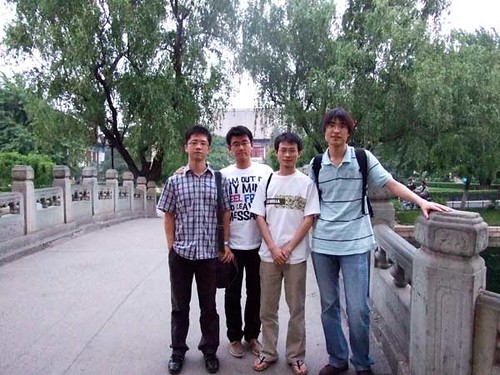
There was no picture with that slot, but the beauty of self-publishing is that I can upload a few here. In this photo, which I took just inside Beida’s West gate, are three members of Beida’s CDM club on the left, with William towering on the right.
I also write about the Beijing-based unregistered NGO CYCAN. Here’s their logo.
And their motto, ditan weilai qingnian zeren – “Low carbon future; youth promise”.
‘Promise’ could more literally be translated as ‘duty’ or ‘responsibility’. And only the future will tell if they live up to it. There’s plenty more to be written about this movement of the world’s most populous demographic – still ‘green behind the ears’ – to fight the world’s most pressing threat.
In late May and early June, I interviewed professors Zhang Weiying and Pan Wei of Peking University (known as ‘Beida’). I wanted to know what the generation who grew up in the Cultural Revolution thought of the generation who grew up in the Consumer Revolution – and who could be leading China in thirty years. Here’s what they said.
*
Zhang Weiying is at the forefront of the ‘New Right’. In (much too) short, that’s the school of thought in China which favours free markets and a clean break from socialism.* Or as Mao might put it, capitalist roaders. Zhang helped to pioneer economic reforms in China in the early 80s, and believes that a propertied class is the foundation of civil society. (“Ownership”, he told me, “is rather a responsibility and respect for other’s property.”)
I asked Professor Zhang if he thought Beida could become a world class university (it was only 36th in this 2007 ranking). His first comment was that in just thirty years in China, the number of students enrolling in college in a given year has multiplied by twenty (roughly 30,000 in 1978, when universities opened again after the learning-free zone of the Cultural Revolution; 600,000 in 2009).* And you expect Beida to be a world class university already?
He also mentioned government control in universities as a factor: Beida can’t diversify the curriculum without autonomy or academic freedom. But the problem runs deeper than that. Many of the faculty don’t encourage creativity in their students – the aim is rather to get the right answer (the “only one”). “New ideas are not encouraged. … If you go through this system,” professor Zhang continued, “you will become narrowminded.”
So is this what he thinks of Beida’s elite students, China’s future? No, of course there are bright sparks of independent thought (especially amongst his own students, of course…). But in the ‘post 80s’ generation as a whole, there is a worrying trend towards ziwozhongxin – self-centeredness. As the first generation of single children (the one-child policy came into effect in 1979), they “take everything for granted”.
One upshot of this, especially for the ‘post 90s’ kids who are not used to hardship (like the generation young during the 60s and 70s are), is that the pressure gets on top of them when they enter university or working life. Professor Zhang pointed to the spate of Foxconn suicides – all young workers who had joined the company just months before – as an example.
But he’s not despairing for China’s youth. After all, “they will grow up.”
*
Pan Wei is on the other side of the political spectrum, the ‘New Left’. He took his PhD at Berkeley, but back in China he was firmly of the opinion that China should follow its own path, not the West’s. His essay ‘Toward a Consultative Rule of Law Regime in China’** is an interesting, provocative read, arguing that democratic elections are an unsuitable model for China.
When I put the same opening question – can Beida become a world class university? -Â to Professor Pan, he rejected its terms. Beida is a world class university if analysed within a Chinese framework, using China’s criteria. (I have to disagree: it really isn’t.) Assessing China from a Chinese perspective – and ideally using the Chinese language – is essential to him.
That’s why – I know I’m digressing – the NPC or renda shouldn’t be thought of as a ‘congress’, according to Professor Pan, because the term paints it as an organ of a Western political system, and so it inevitably comes across as a “rubber stamp” to Westerners. ‘Civil society’, by the same token, isn’t “suitable” for twenty-first century China. Rather, the danwei – work unit - and jiating – household/family - are.
A bigger problem at Beida that Professor Pan identified was the declining number of students from the countryside. According to him, 70% of PKU’s students were from rural areas in the 1950s. 60-70% in the 60s. Today, the number is less than 1%. I can’t check that figure – Chinese universities are secretive about figures which would be public in Britain – but the trend itself is certainly incontestable.
Onto youth. Professor Pan echoed much of what Professor Zhang said. Young Chinese, single children and without the history and suffering of his generation, “become weak”. The same memes of “individualistic” and “psychologically vulnerable” came up. Also an astute comment, I think: that, on the whole, they aren’t interested in their parents’ history (more so in their grandparents’). But you could rephrase: the problem is that parents aren’t interesting in relating their history to their children.
Another result of their upbringing, Professor Pan told me, was “nanxing de nuxinghua” – boys becoming more like girls (or at least “zhongxinghua” – their neuterisation). A boy who is loved excessively (ni ai) can’t fight for himself. At this point, he declared that this results in more homosexuals. This, I should say, was delivered in the spirit of observation not prejudice. I see no factual basis for it.
IÂ won’t comment, expect to add that Professor Pan also said something intelligent: that older people have always had issues with the younger generations.
___
* for a better description, Mark Leonard describes New Right and New Left, as well as profiling professors Zhang and Pan, in his book What does China Think?
** in Debating Political Reform in China, ed. Suisheng Zhao
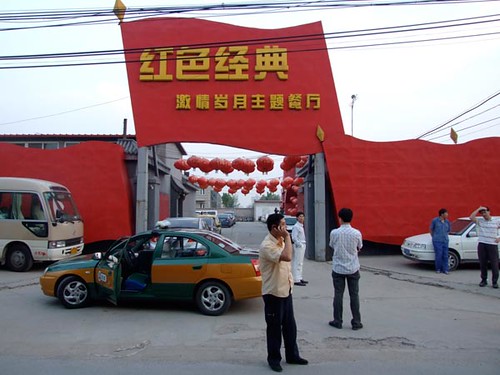
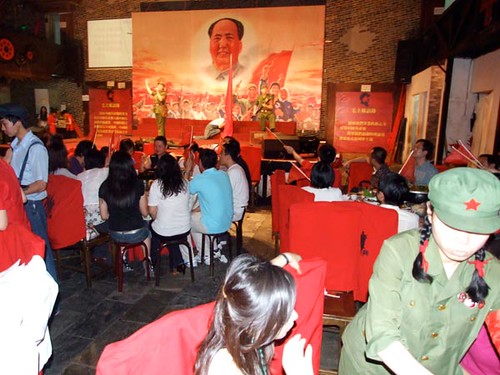
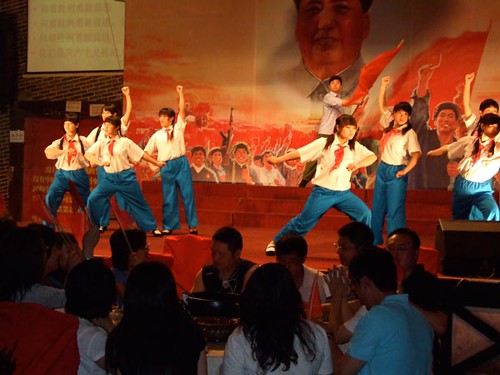
This has been blogged about before, so I’m cheating. But I just can’t resist posting a few pics (in addition to the one I have up on China Beat) and a quick video from Beijing’s Cultural Revolution restaurant, where I had dinner with most of the friends I follow on this blog last Friday night. Yes, June 4th – to complete the political awkwardness of the night.
Out past the fifth ring road, the restaurant is a couple of hours from the student district by subway and (lost) taxi – that’s longer than it takes to get from London to Wales.
A red guard opens our beers and serves our food. As we tuck in, I breath a sigh of relief that this isn’t a Great Leap Forward themed gig.
While the show goes on in the background, I commit the biggest faux pas of my life: giving an ironic toast ‘Long live Mao’ (毛主å¸ä¸‡å²), forgetting that I’d invited two friends from Taiwan along.
By the end of the night, we were all wondering when the Cultural Revolution would give way to Deng Xiaoping’s Reform era. Which it did … when the cheque arrived.
Well, actually that was a few days ago. But before burying another anniversary in the sand, here is a ‘reply thread’ to a facebook note which I was one of the recipients of. I’ve translated it into English, and kept the participants anonymous – but it’s worth noting, as is obvious from some of the content, that they’re all Taiwanese exchange students. (Correction: I’ve since learnt that only one – A – is an exchange student, the other are friends of A in Taiwan, or mainland Chinese.)
A: Tomorrow is 6.4 again. [reposts this article about the Tiananmen mothers]
B: In the strictly controlled Chinese mainland, try your best not to discuss these topics, especially this sensitive moment, from the ROC constitution’s statutory national territory. Today a Taiwanese girl has been arrested in the Shanghai Expo, just for saying that the Expo doesn’t have the Taiwanese national flag. [Ed: read about it here (in Chinese)]
A: Speaking like that, I’m a little afraid …
C: When you’re abroad, be careful.
A: What can you do … I was wrong … I shouldn’t have shared this essay with everyone … I just deleted everything I should delete … but I’m still a little trepid. I’ll certainly be careful with my behavior …
D: haha, if you’re just posting on facebook it’s not too bad, at least facebook is blocked in the mainland, in general you can be as mischievous as you like, it’s no problem.
A: It’s only facebook … everyone shouldn’t keep talking [about this], I’m very afraid …
C: Don’t think too much about it! Being discreet in what you say and do is enough ~
Given the spree of Taiwan-related content up of late (like this awkward moment over dinner), I asked my Taiwanese friend Xu Zhide (å¾è‡³å¾·) the other day if he’d be so kind as to write a guest post for Six. He was.
Zhide is back East for the summer, on break from his studies in London, where he’s writing his graduate thesis on relations between constituent parts of the UK and greater China (full title: ‘Too Many to Tango or Rebirth of Phoenix? Quasi-Asymmetric Federalism in the UK and Greater China’).
If a comparison to the UK-Scotland-Wales-Ireland mess situation seems a roundabout way to discuss mainland China-Taiwan-HK-etc., that’s because it has to be that way: Zhide is also an exchange student at Beida, and a direct approach simply isn’t on. But enough ado, here’s his post (I’ve edited his English for accuracy, being careful not to impact on meaning.)
•
If the question of whether ‘Taiwan is part of China’ is raised in mainland China, no matter if by a 3 or a 90 year old, the answer never differs, as l observed several years ago when l landed here for the first time.
Actually, even now, at least constitutionally, the ROC (Taiwan) claims her sovereignty over ‘whole China’, which is like saying ‘mainland China is part of China’. So a Taiwanese shouldn’t be so suprised that their counterparts in mainland China declare Taiwan to be part of (‘whole’) China as well.
Having said that, these kind of symbolic and self-assertive declarations are, of course, treated more seriously in the latter context, while obviously more lukewarmly in the former context, especially when Taiwanese consider themselves so unique/superior from/than ‘mainlanders’ (or ‘Chinese’) right now.
And this difference makes any conversation on their ‘special relationships’ run less smoothly most of the time, while most Taiwanese, in their daily lives, are also not so aware that the ‘magic power’ to prevent another round of civil war would simply depend on such a constitutional association.
So, some kind of ‘æ— æ‰€è°“’ [‘I really don’t care’] might be a good attitude to foster new relations between both sides in the beginning, as might also be the case in Europe, especially after 90’s.
And that is exactly what l found there recently, too.
Although my lovely classmates in Europe would argue seriously over the root of the current financial crisis, and show their preference of approach towards the remedy of it based on their ethnic backgrounds as differentiated by Anglo-Saxon or Latin, the chance of such a ‘currency war’ turning out to be the end of the Euro Zone, or even EU, is still too distant to tell.
After all, economically, they are so interrelated; emotionally, they are more friends than enemies. And a friend in need is a friend indeed.
Mainland Chinese are also eager to show similar [friendly] feelings towards residents in Taiwan recently, through ECFA and many other efforts.
And although Taiwanese continue to consider their relationship with ‘Chinese’ as more like partners in business, the strategic switch from ‘attacking’ to ‘buying’ Taiwanese in the CCP’s thinking is promising.
One ‘official’ think-tank member even speaks for his ‘boss’ and many others in saying that “the economy coming before politics is precisely politics in its cleverest form”.
It seems that some ‘normative power’ of the EU penetrates and echoes well even in the CCP’s mindset.
So l am pretty sure that our European friends like Alec would also welcome the recent trends happening across the Taiwan Straits. [Ed: sure!]
And although some kind of caution about ‘foreign nations intervening in affairs which are not their own’ is represented in Alec, he could still be proud that efforts at dialogue between cultures, or even civilizations, are also embodied in him: a Chinese-friendly European youth. [Ed: *blush*]
Two years ago, I interviewed Wang Yao, a Chinese journalist at China Youth Daily, who was then on a one year fellowship at the Reuters Institute for the Study of Journalism, in Oxford University. Now back in Beijing, Wang has become editor-in-chief of the paper’s website, China Youth Online (ä¸é’在线). China Youth Daily was not long ago praised by Bill Bishop at Sinocism for publishing a bold article (translated by China Geeks) on the housing crisis.
At the time of the interview, Wang was reluctant for me to publish. But I’ve just asked him again, and he’s fine with it now. When reading his comments, bear two things in mind: a) he was speaking in March 2008, and b) we were speaking in English, a language Wang wasn’t 100% comfortable in. I’ve corrected little grammatical errors which don’t impact on the meaning.
Although I find his first two responses below interesting counterfoils to Western views, Wang said nothing controversial. His concept of a good journalist was the same as mine: a “watchdog … protecting the public interest”. Chinese journalists are not so different to British journalists, he said: there are the good and the bad, and “all good journalists have the same values”:
If you are a good journalist, you should get the respect of the public. The Chinese way, we always say: don’t lose face. It means, if you’re a journalist, you do some bad things, you will lose your face, lose your reputation.
I asked him about censorship. He told me:
In China, I think it’s difficult to translate the word ‘censorship’. It’s the same thing, maybe, in some Arabic countries. Last month, some of my fellows made a presentation about blogs and internet in some Arabic countries. … There is an email [address] for the public to report some bad things on the internet to the government, the email name is censorship@something something. Personally, I don’t know Arabic, but I think censorship is not a very very bad word in Arabic culture. It’s the same thing in China too.
And on another big word, ‘democracy’:
In Chinese, we always say ‘democracy’ or ‘human rights’ are big big words. But personally, I think ‘democracy’ is a kind of life style. I find a very interesting thing when I attend the seminars in Oxford University. And the British way is so many people should ask questions, and the chairman of the seminar should point ‘you, first’ ‘he, second’ and ‘another guy, third’, depending on what time you rise up your hand. Personally I think it’s kind of democracy, it’s kind of democratic lifestyle. And in China, maybe who is the biggest guy, who is the the guy with the highest rank, he might be the first to ask a question.
Earlier in that same month we were speaking (March 2008), Lhasa and other ethnically Tibetan regions had rioted. The Chinese government forbade foreign journalists from entering the Tibetan Automonous Region. I asked Wang for his reaction:
Personally, speaking as a Chinese, if [China] lets all the journalists, including foreign journalists and Chinese journalists to cover what is happening in Tibet, it might be a good way to let the Chinese people, let the people in the world know what’s really happening in China. So I don’t agree with some guys who don’t hope journalists will cover the news in Tibet. There are so many journalists, maybe like you, like me, who can cover the news about Tibet now. I think it’s a good way to reduce misunderstandings.
Wang closed the interview like this:
Chinese media now is totally different – no, can’t say totally different – it’s different compared with five years ago, it changed so quickly. Compared with ten years, it changed very very quickly. And if compared with the media thirty years ago, I think it’s totally different. … It’s true, the editor-in-chief of People’s Daily or China Youth Daily was appointed maybe by the Party leader, but I don’t think all Chinese media is propaganda. I think the best way, like you, is to learn Chinese, to visit China, to talk with the Chinese people, [then] you should know what’s real China, what’s real modern China.
___
Update: here’s an interesting read on Wang’s website, China Youth Online – a bitingly honest appraisal of Beida and Qinghua’s non-status in a recent Asian university rankings list. China Geeks has a translation up here.