
Despite having learnt the word only a week before, it took me far longer than I care to admit to connect è’原 (huangyuan, literally ‘wilderness’) with what Matilda was trying to tell me: that she was a fan of T.S. Eliot’s modernist poem ‘The Wasteland’. (In Chinese translation, that is – and here was me thinking Eliot couldn’t possibly be any more difficult). Matilda is an applied linguistics postgrad and a literature bookworm. Out of interest, I asked her to write down for me a quick list of foreign books she likes. Here it is:
- The Old Man and the Sea (in Chinese, like all the below – although this particular one is surely as easy English as it gets)
- The Count of Monte Cristo (especially the bit where he escapes from prison – which is where I got to myself before giving up)
- Gone with the Wind (the heroine can “eat bitterness” – I’ve heard elsewhere this book is a particular favourite across China)
- Wuthering Heights (especially the vivid nature descriptions – Matilda is also one of the most unabashed romantics I know)
- The Ugly Duckling (as in the children’s story – surely a step down from Bronté?)
At the bottom, she scribbles a Chinese idiom: 读万å·ä¹¦ä¸å¦‚行万里路. “Better walk ten thousand li than read ten thousand books.” Matilda couldn’t disagree more, she tells me: she’d take the books over the exercise anyday. What’s more, she’s not only a reader but an aspiring writer, working – slowly – on her first novel. It’s set in wartime Kunming, where Beida and Tsinghua were relocated to while the Japanese held Beijing, and is a romance between a literature student and her professor.
With her permission, here are the narrator’s opening words in this first draft, along with my English translation (which I found rather tricky, comments welcome):
å¤æžœè¯´åœ¨ç§‹
Summer Fruit in Autumn我ä¸å‡†å¤‡å†™è¯—,也ä¸å‡†å¤‡å†™å°è¯´ã€‚å¯æ˜¯ï¼Œæˆ‘善使文å—,那我总得写些什么。我写的,没有ä¸å¿ƒï¼Œæ²¡æœ‰å¼€å§‹äº¦æ²¡æœ‰ç»“æŸï¼Œæˆ‘åªçŸ¥é“æ˜¯å’Œä½ æœ‰å…³ã€‚ä¸ºæ¤ï¼Œæˆ‘回到了五åå¹´å‰ï¼Œç„¶åŽï¼Œé‡ä¸Šäº†ä½ 。我的记忆ä¸å¥½ä½¿ï¼Œä½ 告诉我,那是个å¤æžœæˆç†Ÿæ—¥ã€‚æˆ‘å› è€Œæœ‰äº†åå—,我å«å¤æžœã€‚
I’m not preparing to write a poem, nor a novel. But I’m apt to use the written word, so I’m always having to write something. What I’m writing doesn’t have a middle, nor a beginning or an end, I only know it’s about you. Therefore, I return to fifty years ago, when I met you. My memory isn’t so good, you tell me – that’s the day when summer fruit ripened. And so I got my name. I’m called ‘Summer Fruit’.
And so the story begins (“我已ä¸è®°å¾—那时的昆明天气如何…”; “I already can’t remember what the weather was like in Kunming at that time…”), but there I’ll leave you all in tantalising suspense until publication day. Instead, here’s a late merry Christmas picture from the author, doubly merry for its tardiness:
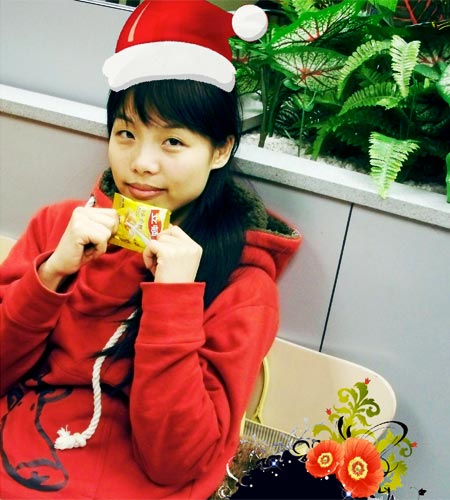
-
Kaiwen: well, if it isn’t about exercise, why not take the bus? then you can read ten thousand books *while* traveling ten thousand miles. much better.
-
Long time listener, first time caller…
“she’d take the books over the exercise anyday”
The idiom isn’t referring to exercise. It’s about getting real world experiences (from travelling around, which is what the åƒé‡Œè·¯ is about).
Also, the idiom, at least as it appears in my dictionary, is 读万å·ä¹¦ï¼Œè¡Œåƒé‡Œè·¯ (or the reverse) — it doesn’t predjudice one over the other with a ä¸å¦‚.
– K
-
Intriguing opening…


Comments are now closed.
Alec Ash
 I studied Mandarin in Beijing, where I began writing this blog in the Olympic summer of 2008
3 comments